

Welcome to today’s Battle Royale featuring two roofing heavyweights: “TPO” in the east corner versus “PVC” in the west!
Tonight’s showdown pits these contenders against each other across six punishing rounds designed to test every aspect of their performance for Industrial Roof Design Efficiency.
At stake? Millions in potential costs, decades of building protection, and the critical performance demands of modern commercial and industrial facilities.
Our professional judging panel will evaluate each round on technical merit, real-world performance, and value delivery. After all six rounds, we’ll declare our ultimate champion.
Ladies and gentlemen, facility managers and building owners… it’s time to rumble!
ROUND 1: INITIAL COSTS & INSTALLATION
In the high-stakes world of industrial roofing, the battle between TPO and PVC membranes can make or break your bottom line. With material costs soaring and skilled labor at a premium, choosing the wrong system could leave you hemorrhaging money faster than a leaky roof during monsoon season.
Material Expenses
Let’s cut through the marketing fluff and talk real numbers. TPO membrane typically runs $3-5 per square foot, while PVC commands a premium at $5-8 per square foot. That price gap can balloon into six figures on larger industrial projects.
TPO’s wallet-friendly price point makes it the darling of value-engineered projects. The material delivers solid performance without the premium pricing, making it particularly attractive for facilities with tight capital expense budgets.
PVC’s higher price tag comes with enhanced chemical resistance and superior durability. However, unless your facility houses particularly harsh chemicals or faces extreme conditions, that premium might be overkill.
For pure cost considerations, TPO takes the “ADVANTAGE” here – it’s like getting business class performance at economy class prices.
Installation Complexity
TPO installation is about as straightforward as industrial roofing gets. The lightweight sheets are easier to maneuver, and the seam-welding process doesn’t require the finesse of brain surgery.
PVC installation demands more skill and precision, particularly around those notorious heat-welded seams. Get it wrong, and you’ll be playing whack-a-mole with leaks faster than you can say “warranty claim.”
While both materials require certified installers, TPO’s forgiving nature means crews can work more efficiently. This translates to fewer callbacks and less time spent supervising the installation process.
TPO claims another clear “ADVANTAGE” in this category – sometimes simpler really is better.
Project Timeline
Time is money in industrial roofing, and every day your facility sits exposed to the elements is a day of potential disaster. TPO’s easier handling and simpler installation process typically shaves days or even weeks off project timelines.
PVC’s more demanding installation requirements can stretch timelines like a rubber band. Those precision-welded seams take time to get right, and rushing the job is about as smart as skydiving with a knockoff parachute.
The math here is simple: faster installation means faster return to normal operations. TPO’s speedier completion times earn it another “ADVANTAGE” in this category.
ROUND 1 WINNER: TPO
ROUND 2: DURABILITY & LIFESPAN
When it comes to industrial roofing, durability isn’t just a fancy buzzword – it’s the difference between a roof that lasts decades and one that becomes a money pit faster than you can say “total replacement.” With material and labor costs skyrocketing, choosing between TPO and PVC could mean either celebrating your retirement or spending it patching leaks.
Material Resistance to Elements
TPO membranes handle UV rays like a champ and maintain their cool under the summer sun. However, they can be as sensitive to punctures as a politician’s ego, requiring vigilant protection from falling debris and maintenance traffic.
PVC laughs in the face of chemicals that would make other membranes cry uncle. Its molecular structure makes it nearly impervious to industrial pollutants, grease, and animal fats that can turn lesser membranes into Swiss cheese.
While both materials can handle basic weather challenges, PVC’s superior chemical resistance and toughness earn it a clear ADVANTAGE in this category.
Expected Lifespan and Warranty
TPO roofs typically promise 15-25 years of service, but like a used car salesman’s guarantee, actual results may vary. Environmental conditions and installation quality can significantly impact their longevity.
PVC systems routinely deliver 20-30 years of reliable service, backed by warranties that don’t require a magnifying glass to read the fine print. These roofs aren’t just surviving – they’re thriving decades after installation.
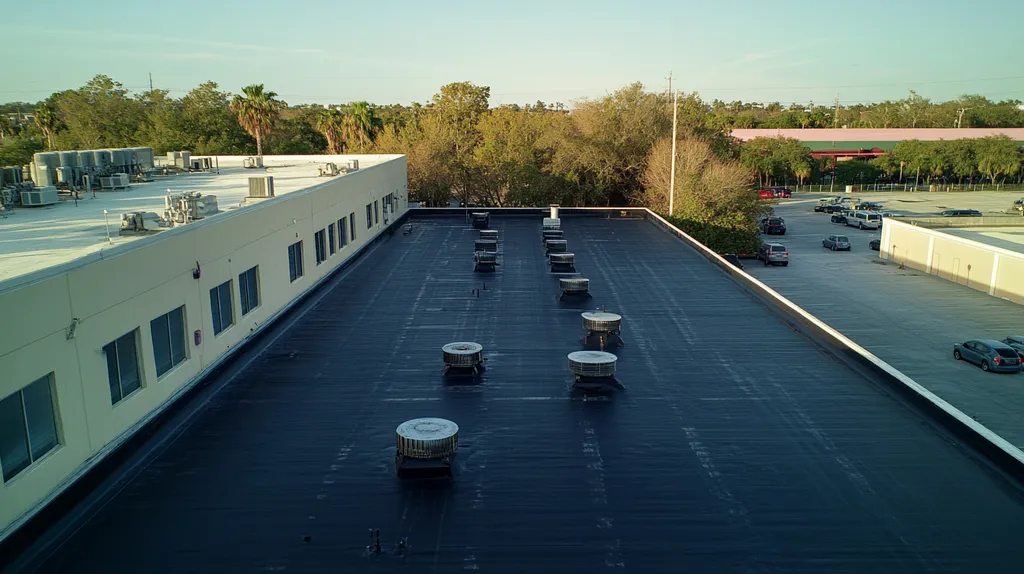
Flat roofs must provide reliable long-term performance while accommodating various installations like HVAC systems and solar panels. (source: SRCTN)
PVC’s proven track record and longer lifespan give it the ADVANTAGE here.
Maintenance Requirements
TPO systems demand attention like a needy houseplant. Regular inspections, prompt repairs, and careful monitoring of seams are essential to prevent premature aging and system failure.
PVC membranes are more like desert cacti – tough, resilient, and requiring minimal maintenance to thrive. Their robust construction means fewer emergency calls and less frequent repairs.
When it comes to keeping your maintenance team off the roof and your budget in check, PVC claims another clear ADVANTAGE.
ROUND 2 WINNER: PVC
ROUND 3: PERFORMANCE FACTORS
In the high-stakes world of industrial roofing, performance isn’t just about staying dry – it’s about protecting millions in assets and operations. A single performance failure can cascade into production delays, damaged inventory, and skyrocketing energy costs faster than you can say “emergency repair crew.”
Chemical and UV Resistance
Industrial environments throw everything from caustic fumes to oil vapors at roofing membranes. TPO holds its own against basic chemical exposure but can show weakness when faced with prolonged exposure to industrial pollutants.
PVC’s molecular structure makes it virtually bulletproof against harsh chemicals. Its superior resistance to oils, greases, and industrial exhaust means it maintains integrity even in the most challenging environments.
For facilities dealing with chemical exposure, PVC’s proven track record of chemical resistance earns it a clear “ADVANTAGE” in this category.
Thermal Performance
TPO shines bright when it comes to thermal performance. Its highly reflective surface acts like a mirror for solar radiation, dramatically reducing cooling loads and energy costs during peak summer months.
PVC offers solid reflectivity but typically doesn’t match TPO’s performance in this arena. While both materials meet Energy Star requirements, TPO’s superior solar reflectance gives it the edge in hot climates.
When it comes to keeping your facility cool and your energy bills lower, TPO claims the “ADVANTAGE.”
Fire and Weather Protection
TPO provides decent fire resistance and weather protection, but it’s like bringing a knife to a gunfight when extreme conditions hit. While it meets basic fire safety standards, its performance in severe weather can be inconsistent.
PVC stands like a fortress against both fire and extreme weather. Its inherent fire resistance and superior seam strength make it the go-to choice for facilities where safety cannot be compromised.
For critical fire safety and severe weather protection, PVC takes the “ADVANTAGE.”
ROUND 3 WINNER: PVC
ROUND 4: MAINTENANCE REQUIREMENTS
In the unforgiving world of industrial roofing, maintenance isn’t just a line item – it’s the difference between a roof that protects your facility and one that becomes an ATM for repair contractors. With replacement costs reaching astronomical heights, choosing between TPO and PVC’s maintenance demands could mean the difference between strategic planning and crisis management.
Routine Inspections and Cleaning
TPO membranes demand attention like a helicopter parent. Their surfaces require regular cleaning to maintain reflectivity, and seams need frequent inspection to catch potential failures before they become catastrophes.
PVC systems are more like the strong silent type. Their inherent chemical resistance means less frequent cleaning, and their robust seam strength reduces the need for constant inspection.
When it comes to minimizing inspection headaches and maintenance frequency, PVC claims the ADVANTAGE.
Repair Complexity
TPO repairs can be as tricky as performing surgery while wearing boxing gloves. As these membranes age, finding the right repair products and achieving proper weld temperatures becomes increasingly challenging.
PVC repairs are more straightforward, with consistent welding temperatures and widely available repair materials. Even aged membranes maintain their weldability, making repairs more reliable and less time-consuming.
For ease of repairs and long-term maintainability, PVC takes another clear ADVANTAGE.
Energy Efficiency Maintenance
TPO’s initial brilliant white surface can dull faster than a neglected paint job. Maintaining its energy-efficient reflective properties requires regular cleaning and occasional recoating.
PVC maintains its reflective properties with minimal intervention, helping facilities reduce energy costs over the long term. Its surface stays cleaner longer and resists the dulling effects of age and weathering. Energy-efficient roofing solutions not only align with sustainability goals but also offer financial advantages in the form of reduced energy expenses. (source: Preferred Roofing Services)
For maintaining energy efficiency with minimal effort, PVC earns the ADVANTAGE.
ROUND 4 WINNER: PVC
ROUND 5: SUSTAINABILITY CREDENTIALS
In today’s industrial roofing arena, sustainability isn’t just about feeling good – it’s about cold, hard cash. With carbon taxes looming, energy costs soaring, and clients demanding green credentials, choosing between TPO and PVC could mean the difference between leading the market or getting left behind in regulatory purgatory.
Environmental Impact
TPO brings serious green credentials to the table. Its chlorine-free composition and 100% recyclable nature make it the darling of environmental assessors and LEED certification teams.
PVC’s environmental story is more complicated than a government tax form. While durable enough to avoid frequent replacement, its production process releases concerning levels of dioxins and other chemical nasties.
The recyclability factor seals the deal here. While PVC can technically be recycled, finding facilities willing to process it is harder than finding a vegetarian at a steakhouse.
For pure environmental impact, TPO claims the clear “ADVANTAGE”.
Energy Efficiency
TPO’s highly reflective surface works like a cosmic mirror, bouncing solar radiation back into space instead of your facility’s HVAC system. Initial solar reflectance ratings often exceed 0.90, keeping cooling costs manageable even during heat waves.
PVC delivers respectable reflectivity but can’t quite match TPO’s stellar performance. Most PVC membranes hover around 0.80-0.85 reflectance, which is like bringing a water pistol to a firefight.
Flat roofs must efficiently support various installations while maintaining optimal thermal performance. TPO’s superior reflectivity makes it particularly effective for facilities looking to maximize rooftop solar panel efficiency. (source: SRCTN)
When it comes to keeping your energy bills from going nuclear, TPO takes another clear “ADVANTAGE”.
Material Lifecycle
TPO’s production process is cleaner than a surgeon’s operating room. The material requires less energy to manufacture and can be completely recycled at end-of-life, creating a closed loop that would make any sustainability manager weep with joy.
PVC’s lifecycle story reads like a horror novel for environmentalists. From cradle to grave, it leaves a trail of chemical compounds that would make a hazmat team nervous.
For those keeping score on cradle-to-grave impact, TPO scores yet another “ADVANTAGE”.
ROUND 5 WINNER: TPO
ROUND 6: SPECIALIZED APPLICATIONS
When it comes to specialized industrial applications, choosing the wrong roofing system is like bringing a butter knife to a gunfight. Modern facilities face increasingly complex challenges – from caustic chemical exposure to extreme temperature fluctuations that can turn a roof into Swiss cheese faster than you can say “total replacement.”
With specialized application failures costing facilities millions in damaged inventory, production delays, and emergency repairs, the stakes couldn’t be higher. Let’s dive into how TPO and PVC handle these mission-critical scenarios.
Chemical and Industrial Exposure
TPO’s chemical resistance is like a lightweight boxer stepping into the heavyweight ring. While it handles basic exposure adequately, prolonged contact with industrial chemicals can lead to premature deterioration and membrane failure.
PVC struts into chemical warfare like a tank, shrugging off attacks from oils, greases, and industrial pollutants that would destroy lesser membranes. Its molecular structure creates an almost impenetrable barrier against even the most aggressive chemical cocktails.
For facilities where chemical exposure is a daily reality, PVC’s superior resistance makes it the clear “ADVANTAGE” holder.
Extreme Temperature Management
TPO performs like a champion in moderate conditions but can show weakness in temperature extremes. Repeated thermal cycling can stress seams and accelerate aging, particularly in facilities with significant temperature fluctuations.
PVC maintains its composure even when temperatures swing like a pendulum. Its superior dimensional stability and reinforced seams handle thermal shock without breaking a sweat.
When it comes to managing extreme temperature variations, PVC claims another “ADVANTAGE.”
Rooftop Equipment Integration
TPO installation around rooftop equipment can be as delicate as performing surgery with oven mitts. While the membrane is lightweight and flexible, achieving proper seals around complex penetrations requires extensive detailing.
PVC’s superior weldability and proven track record with equipment integration make it the go-to choice for facilities with extensive rooftop installations. Energy-efficient roofing solutions must accommodate various equipment while maintaining optimal performance and reducing energy consumption. (source: Preferred Roofing Services)
For reliable equipment integration and long-term performance, PVC takes the “ADVANTAGE.”
ROUND 6 WINNER: PVC
AND THE WINNER IS…
After six grueling rounds of technical combat, with victories traded back and forth like heavyweight punches, we have our verdict!
With four rounds to two, PVC emerges as our undisputed champion! Its knockout performance in durability, chemical resistance, specialized applications, and maintenance requirements proved decisive in this industrial roofing showdown.
PVC dominated the later rounds with its superior chemical resistance, unmatched durability, and exceptional performance in extreme conditions. When the stakes are highest and facility demands are most intense, PVC delivers championship-caliber protection.
But don’t count TPO out! This scrappy contender still packs a powerful punch in cost-efficiency and sustainability. For facilities with tight budgets and aggressive environmental goals, TPO remains a formidable choice worthy of consideration.
Remember, folks – every building tells its own story. Local climate conditions, facility operations, and specific property requirements can shift these rankings faster than a referee’s decision. While PVC takes home the belt tonight, your facility’s unique circumstances might favor a different champion.
Professional consultation is essential for making the final call. Building owners and facility managers should always partner with qualified roofing professionals who can evaluate their specific situation.
In the high-stakes arena of industrial roofing, victory doesn’t go to the strongest contender – it goes to the right contender for YOUR facility’s fight!
FREQUENTLY ASKED QUESTIONS
Q. What are the initial costs for a commercial roof using TPO or PVC?
A. TPO materials typically cost $3-5 per square foot, while PVC ranges from $5-8. This price difference can significantly impact larger projects, making TPO a more budget-friendly option without sacrificing performance for facilities on a tighter budget.
Q. Which industrial roof option is more durable over time?
A. PVC membranes generally offer a superior lifespan of 20-30 years compared to TPO’s 15-25 years. PVC’s stronger chemical resistance means you won’t be patching leaks as often, saving your facility from costly repairs in the long run.
Q. How do TPO and PVC perform in industrial environments?
A. TPO provides solid thermal performance with high solar reflectivity, helping to lower cooling costs. Conversely, PVC excels in resisting harsh chemicals and extreme conditions, making it well-suited for tougher industrial applications.
Q. Which roofing option has lower maintenance requirements?
A. PVC roofs generally require less regular inspection and maintenance due to their durability. TPO requires more attention to keep seams intact and maintain energy efficiency, whereas PVC’s robust structure allows it to thrive with minimal oversight.
Q. How do TPO and PVC compare in sustainability impact?
A. TPO shines with its chlorine-free makeup and 100% recyclability, making it a green choice. PVC, while durable, releases harmful dioxins during production, complicating its environmental credential compared to TPO.
Q. What specialized applications suit TPO or PVC membranes better?
A. PVC is ideal for environments with extreme temperature variations or severe chemical exposure due to its superior resilience. TPO may struggle under these conditions, making PVC a safer bet for critical applications.
Q. How does installation complexity differ between TPO and PVC roofs?
A. TPO offers straightforward installation, allowing for quicker setup by crews. In contrast, PVC requires skilled labor for heat-welded seams, which can complicate the process, leading to longer installation times and potential delays.






